How to Calculate a Weighted Grade
Learn how to calculate a weighted grade step by step. Simple formula, a worked example with categories, common mistakes, and a free calculator.
 By Dhananjay Kumar Nirala , Writer schedule 5 min read
chevron_right On this page 7 sections
Want to know how to calculate a weighted grade, where homework, quizzes, and exams each count for a different amount? It is simpler than it looks. You find your score in each part, multiply it by how much that part is worth, and add the results together. This guide shows you the formula, walks through a full example with real categories, and points you to a free Weighted Grade Calculator if you would rather skip the steps.
What a weighted grade actually means
In a lot of classes, not every score counts the same. Your final exam might matter far more than a single homework sheet. A weighted grade is a way of giving each type of work the right amount of pull on your final grade.
The teacher splits the class into groups, often called categories. Common ones are homework, quizzes, exams, projects, and participation. Each category gets a weight, which is the percent of your final grade it is worth. For example, exams might be worth 50%, homework 20%, quizzes 20%, and participation 10%.
All the weights together should add up to 100%. A high weight means that category moves your grade a lot, so a strong exam score helps much more than a strong homework score when exams carry more weight.
The weighted grade formula
Here is the formula in plain form.
Weighted grade = (Score₁ × Weight₁) + (Score₂ × Weight₂) + ... for every category
Each score is your percent in that category, and each weight is that category's share of the grade as a decimal. So a 30% weight becomes 0.30.
There are three quick steps. First, work out your percent in each category by dividing your points by the points possible. Next, multiply each percent by that category's weight. Last, add all those results together. The total is your weighted grade.
As long as your weights add up to 100%, you can stop there. If they do not, you divide by the total weight at the end, but the next example keeps it simple with weights that already total 100%.
A step-by-step example
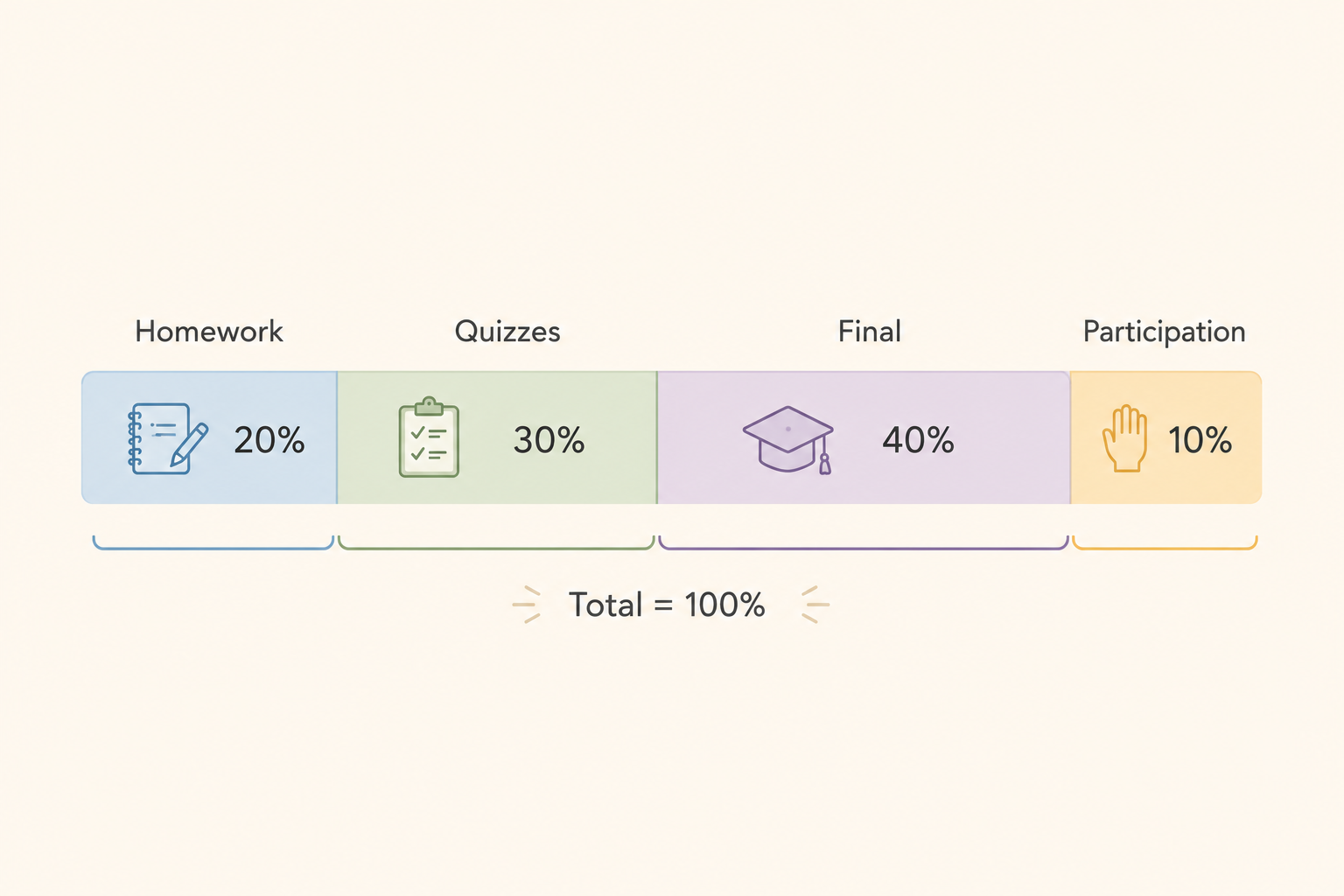
Say your class has four categories with these weights and your scores in each.
Homework is worth 20%, and you have 90%. Quizzes are worth 30%, and you have 75%. The final exam is worth 40%, and you have 85%. Participation is worth 10%, and you have 100%.
First, turn each weight into a decimal and multiply it by your score in that category. Homework is 90 × 0.20 = 18. Quizzes are 75 × 0.30 = 22.5. The final is 85 × 0.40 = 34. Participation is 100 × 0.10 = 10.
Now add those four results together. 18 + 22.5 + 34 + 10 = 84.5.
So your weighted grade is 84.5%, which is a B in most grading scales. Notice the weights add up to 100%, so there is no extra step at the end.
Why a weighted grade is not the same as a plain average
It helps to see the difference. If you just took the four scores from the last example and found a plain average, you would do (90 + 75 + 85 + 100) ÷ 4 = 87.5%. But the weighted grade came out to 84.5%.
Why the gap? A plain average treats every category as equal. The weighted grade does not. Your 100% in participation only counts for 10%, so it barely lifts your grade. Your 85% on the final counts for 40%, so it pulls much harder. The parts worth more shape your grade more.
This is why checking a plain average can fool you. Two students with the same scores can finish with different grades if their classes weight the categories differently. The weighted grade is the one that matches your report card.
A common mistake: weights that don't add up to 100
The formula is clean when your weights total 100%. The trouble starts when they do not. This happens a lot in the middle of a term, when some categories have not been graded yet.
Say only two categories are done so far. Homework is worth 20% and you have 88%. Quizzes are worth 15% and you have 80%. Together those weights are only 35%, not 100%. If you just add 88 × 0.20 and 80 × 0.15, you get 29.6, which is not a real grade.
The fix is to divide by the total weight you actually have. So 29.6 ÷ 0.35 = 84.6%. That is your grade so far, based only on what has been graded. The free calculator handles this for you, so you do not have to remember the extra step.
Skip the math with a calculator
Once you understand the steps, a tool saves time and avoids slips, especially when you have five or six categories. Our free Weighted Grade Calculator lets you type each category, its weight, and your score, and it gives you the weighted grade right away. It also handles weights that do not add up to 100 yet, so it works mid-term too.
If you want to look further ahead, the Final Grade Calculator shows what you need on an upcoming exam, and the GPA Calculator turns your grades into a GPA across all your classes.
Conclusion
Once you know how weighted grades work, your report card stops being a surprise. Find your percent in each category, give each one its weight, and add them up.
The parts worth more carry more, which is exactly the point. When you would rather not do it by hand, the Weighted Grade Calculator gives you the answer in seconds.