How to Convert a Percentage to a Letter Grade
 By Dhananjay Kumar Nirala , Writer schedule 5 min read
chevron_right On this page 8 sections
Want to convert a percentage to a letter grade fast? Most US schools use the same simple scale. 90% or higher is an A. The 80s are a B. The 70s are a C. The 60s are a D. Below 60 is an F.
This guide gives you the full chart. It also shows the plus and minus version some schools use. And if you just want a quick answer, the free Percentage to Letter Grade calculator checks any score for you.
The standard grade scale
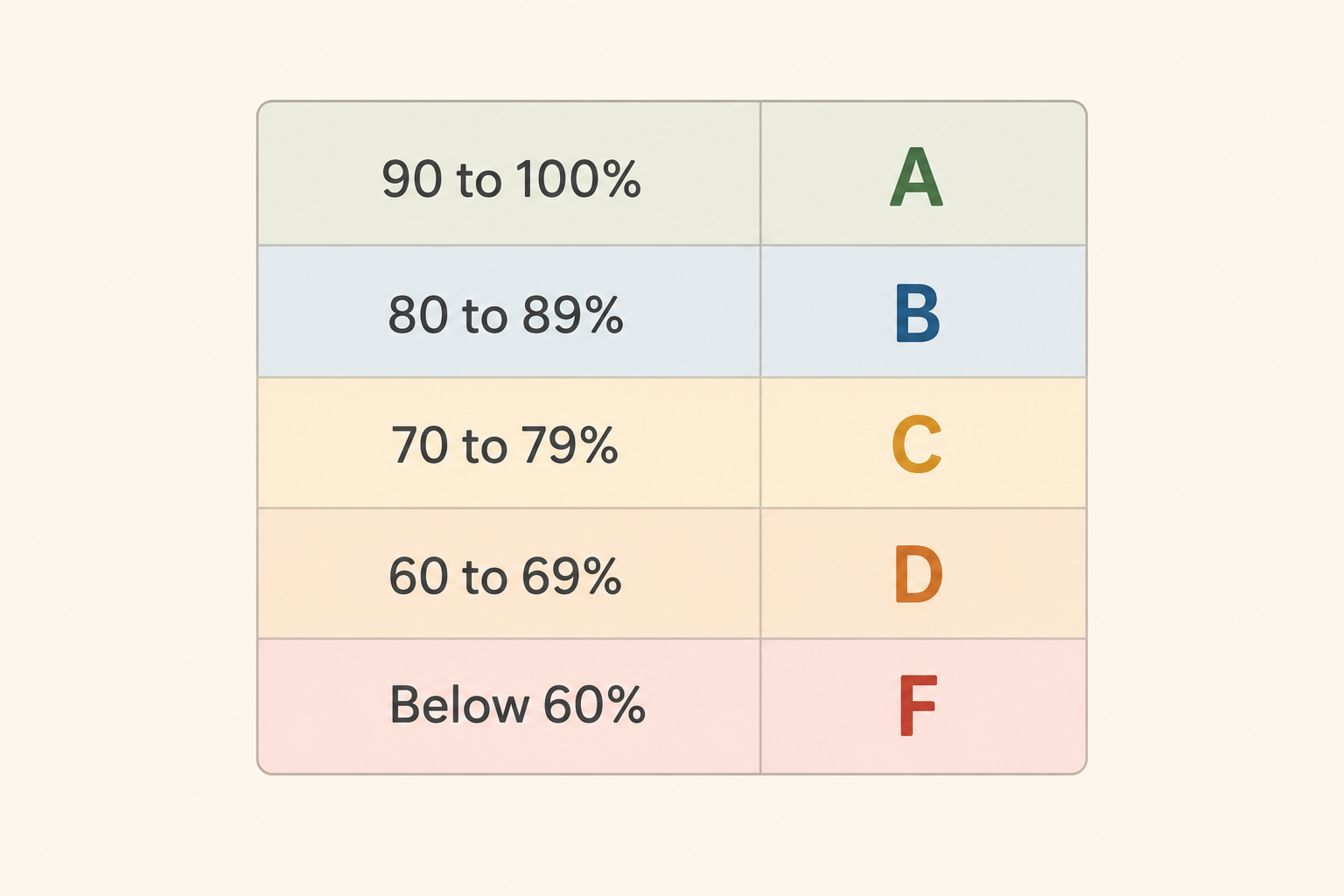
Most high schools and many colleges use this basic scale. Find the range your percentage falls in, and that is your letter grade.
Percentage | Letter grade |
|---|---|
90 to 100% | A |
80 to 89% | B |
70 to 79% | C |
60 to 69% | D |
Below 60% | F |
So an 84% is a B, and a 73% is a C. This scale is easy to remember because each letter covers a clean ten-point band. Anything under 60% is a failing grade in most schools.
The plus and minus scale
Many colleges use a more detailed scale. It splits each letter into three parts, so a high B becomes a B+ and a low B becomes a B-. This gives a fairer picture of where you landed inside a band.
Percentage | Letter grade |
|---|---|
93 to 100% | A |
90 to 92% | A- |
87 to 89% | B+ |
83 to 86% | B |
80 to 82% | B- |
77 to 79% | C+ |
73 to 76% | C |
70 to 72% | C- |
67 to 69% | D+ |
63 to 66% | D |
60 to 62% | D- |
Below 60% | F |
On this scale, a 91% is an A- instead of a plain A, and an 88% is a B+. The cutoffs are not the same at every school, so the next section is worth a quick read before you trust any chart.
How to find your letter grade
Start with your percentage. If you only have points, turn them into a percent first. Divide your score by the total and multiply by 100. So 27 out of 30 becomes 27 ÷ 30 × 100, which is 90%.
Now you need the right scale. Some schools use the plain A to F scale, while others use the plus and minus version. Your syllabus usually tells you which one, so it is worth a quick look.
Once you know the scale, just find the row your percent falls in and read the letter beside it. The same 90% is an A on the standard scale, but only an A- on the plus and minus scale. That is why picking the right scale matters.
Why your school's cutoffs might be different
The charts above are the common ones, but they are not a rule every school follows. Cutoffs change from one place to the next, and the gap can matter.
Some colleges are stricter and ask for 94% to give an A, not 90%. A few schools drop the D grade and treat anything below 70% as failing. Others shift the plus and minus bands by a point or two. None of this is wrong, it is just each school setting its own line.
So before you lock in a letter grade, check your syllabus or your school's grading policy. It takes a minute and saves you from reading your grade one band too high or too low.
Quick examples
Here is how a few common scores look on each scale.
A 95% is an A on either scale. An 88% is a B on the standard scale, or a B+ on the plus and minus scale. A 72% is a C on the standard scale, but a C- on the plus and minus one. A 67% is a D on the standard scale, or a D+ with plus and minus. A 59% is an F on both.
Notice that the letter only changes when you switch scales near the edges of a band. A score sitting in the middle, like 95%, lands on the same letter no matter which scale your school uses.
Skip the lookup with a calculator
Charts are handy, but typing one number is faster. Our free Percentage to Letter Grade calculator takes your percent and shows the letter right away, so you do not have to scan a table or worry about the bands.
If you want to go a step further, the Percentage to GPA calculator turns your score into a GPA point, and the Letter Grade calculator works out a letter straight from your marks. All of them are free and need no signup.
Conclusion
Once you know your percent and which scale your school uses, the letter grade is easy to spot. For most people the plain A to F chart is all they need. The plus and minus scale just splits things a little finer. Keep the chart handy, or let the Percentage to Letter Grade calculator do the lookup for you.