How to Calculate Your Average Grade
Calculate your average grade with one simple formula. Clear examples, a common scale mistake to avoid, and a free average grade calculator
 By Dhananjay Kumar Nirala , Writer schedule 7 min read
chevron_right On this page 11 sections
- 01 The average grade formula
- 02 A worked example
- 03 Put every score on the same scale first
- 04 Average grade vs weighted grade
- 05 Quick examples
- 06 How to find your semester or class average
- 07 How to raise your average grade
- 08 Rounding your average grade
- 09 Quick examples
- 10 Skip the math with a calculator
- 11 Conclusion
Want to calculate your average grade across a few tests? It takes one quick step. Add all your scores together, then divide by how many scores there are. So three tests of 80, 90, and 85 give you (80 + 90 + 85) ÷ 3 = 85%.
This guide shows the formula, works through a full example, and links to a free Average Grade calculator for an instant answer.
The average grade formula
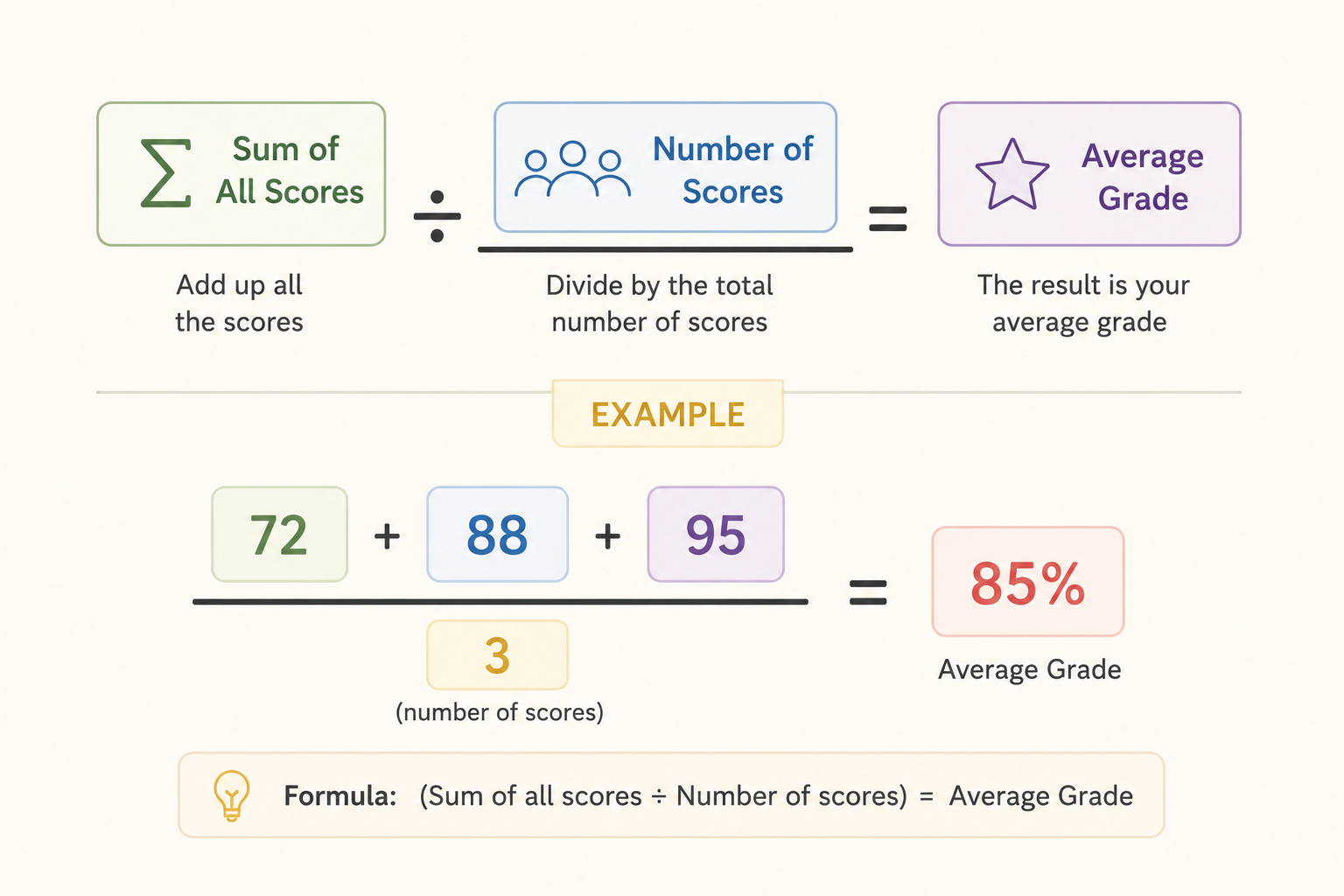
The formula for an average grade is short. Add up all your scores, then divide by how many scores you have.
Average grade = Sum of all scores ÷ Number of scores
This is just the plain average, also called the mean. Every score counts the same, so one test does not matter more than another. Say you scored 72, 88, and 95 on three tests. Add them. 72 + 88 + 95 = 255. Then divide by 3. 255 ÷ 3 = 85%.
That is your average grade. The next part works through a longer example so the steps are clear.
A worked example
Say you took six science tests and want your average across all of them. Your scores are 90, 95, 100, 76, 88, and 80.
First, add every score together. 90 + 95 + 100 + 76 + 88 + 80 = 529.
Next, count how many scores there are. In this case, six.
Last, divide the total by that count. 529 ÷ 6 = 88.17%.
So your average grade across the six tests is 88.17%. The same three steps work for any number of scores, whether it is two quizzes or twenty.
Put every score on the same scale first
The average only works when all your scores use the same scale. If one test is out of 50 and another is out of 100, you cannot just average the raw numbers. They do not mean the same thing.
Turn each score into a percentage first. Divide the score by its total and multiply by 100. So 45 out of 50 becomes (45 ÷ 50) × 100 = 90%, and 80 out of 100 stays 80%. Now both are percentages, so you can average them. (90 + 80) ÷ 2 = 85%.
Skipping this step is the most common reason an average comes out wrong. When in doubt, change every score to a percent before you add.
Average grade vs weighted grade
A plain average treats every score the same. That is fine when all your tests count equally. But many classes do not work that way. The final exam might be worth far more than a quiz.
When some scores count more than others, you need a weighted grade instead. There you multiply each score by how much it is worth, then add those up. The result reflects the parts that matter most. If that sounds like your class, the free Weighted Grade calculator works it out for you.
So use a plain average when everything counts equally, and a weighted grade when it does not. Checking your syllabus tells you which one fits.
Quick examples
Here are a few averages worked out so you can match yours.
Two tests of 80 and 90 give an average of (80 + 90) ÷ 2 = 85%. Three tests of 70, 75, and 95 give (70 + 75 + 95) ÷ 3 = 80%. Four tests of 88, 92, 79, and 85 give (88 + 92 + 79 + 85) ÷ 4 = 86%.
The count changes, but the steps never do. Add the scores, then divide by how many there are.
How to find your semester or class average
Your semester average works the same way as any average. Add the grades from each marking period, then divide by how many there are. If your two terms were 84% and 90%, your semester average is (84 + 90) ÷ 2 = 87%. If your school counts a final exam as its own piece, add it in and divide by three.
A class average is a little different. Teachers use it to see how a whole class did on one test. Add up every student's score, then divide by the number of students. So if five students scored 70, 85, 90, 60, and 95, the class average is (70 + 85 + 90 + 60 + 95) ÷ 5 = 80%.
Both are just a mean. The only thing that changes is what you are averaging, your own terms or a group of students.
How to raise your average grade
Once you know your average, raising it is mostly about where you put your effort. A few simple habits make the biggest difference.
Keep an eye on your current average instead of waiting for the report card. When you check after each test, you know early if you are slipping. Put more time into the tests that are coming up, since a fresh high score lifts your average more than fixing an old one.
Do not skip the small assignments either. A few missed homework scores can quietly drag your average down. And if your class drops the lowest score, find out which one it is, because one bad test may count less than you think.
Rounding your average grade
Averages often come out with a long decimal, like 87.33%. Most schools round to a whole number, so that becomes 87%. A score of 89.5% usually rounds up to 90%, which can be the line between one letter grade and the next.
One thing to watch. Only round at the very end, after you have the final average. If you round each score first, the small errors add up and your answer comes out wrong. Keep the full numbers while you work, then round once at the end.
Rounding rules are not the same everywhere, so check your syllabus. Some teachers round at 0.5, and others only round up at 0.7 or higher.
Quick examples
Here are a few averages so you can check your own fast.
Two tests of 78 and 86 average to (78 + 86) ÷ 2 = 82%. Three tests of 90, 84, and 96 average to (90 + 84 + 96) ÷ 3 = 90%. Five quizzes of 70, 80, 75, 95, and 100 average to (70 + 80 + 75 + 95 + 100) ÷ 5 = 84%.
The number of scores changes, but the method stays the same. Add them all, then divide by how many there are.
Skip the math with a calculator
Adding a long list of scores by hand is slow and easy to slip up on. Our free Average Grade calculator adds every score and divides for you, so you get the average right away.
If your tests count for different amounts, the Weighted Grade calculator handles that instead. And to turn your average into a GPA, the GPA calculator does it in one step. All free, no signup.
Conclusion
An average grade is one of the easiest numbers to work out. Add your scores, divide by how many there are, and round at the end. The same method covers a few quizzes, a full semester, or a whole class. When you would rather not do it by hand, the Average Grade calculator gives you the answer in a second.