How to Calculate Percentage From Marks
Learn how to calculate percentage from marks with a simple formula. Covers single and multiple subjects, a common mistake, and a free calculator.
 By Dhananjay Kumar Nirala , Writer schedule 4 min read
chevron_right On this page 6 sections
Want to calculate percentage from marks the easy way? The formula is short. Divide your marks by the total marks, then multiply by 100. So 85 out of 100 is (85 ÷ 100) × 100 = 85%. The same steps work whether you have one subject or ten. This guide covers both, points out a mistake many people make, and links to a free Marks to Percentage calculator for an instant answer.
The marks percentage formula
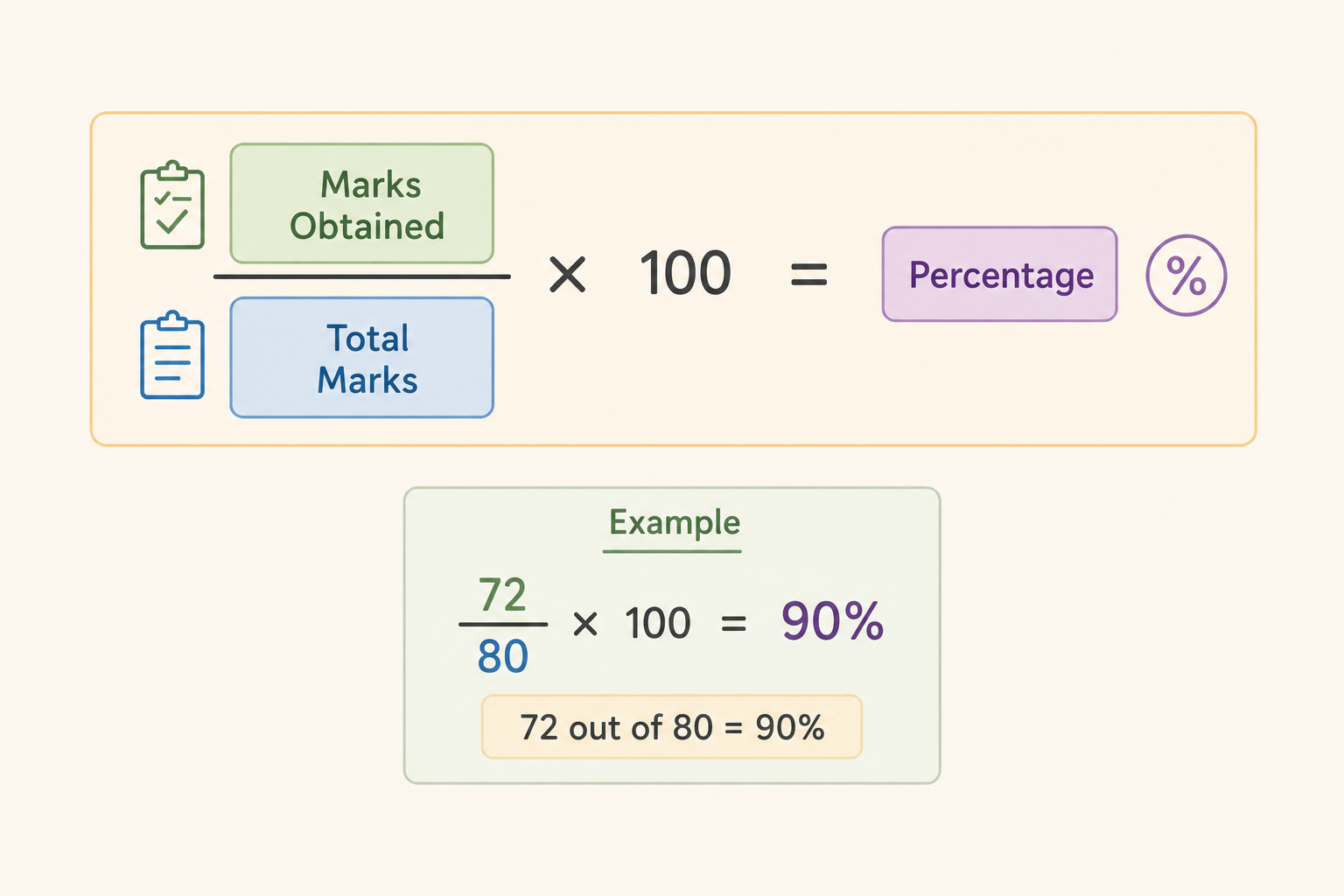
Here is the formula to calculate the percentage of marks for a single subject or test.
Percentage = (Marks obtained ÷ Total marks) × 100
First, divide the marks you got by the total marks. Then multiply by 100 to turn it into a percent. Say you scored 72 out of 80. That is 72 ÷ 80 = 0.9, and 0.9 × 100 = 90%.
This is the percentage from total marks for one paper. The next part shows how to handle several subjects together, which is where most people slip up.
Overall percentage for multiple subjects
When you have more than one subject, do not work them out one by one. Add all the marks you got, add all the total marks, and then use the same formula once.
Overall percentage = (Total marks obtained ÷ Total maximum marks) × 100
Say your marks are Math 80 out of 100, Science 45 out of 50, and History 180 out of 200. Add the marks you got. 80 + 45 + 180 = 305. Now add the totals. 100 + 50 + 200 = 350. Then divide and multiply by 100. (305 ÷ 350) × 100 = 87.14%.
This is your overall percentage of all subjects, sometimes called the aggregate percentage. It works for any number of subjects, as long as you add the marks and the totals correctly.
A common mistake to avoid
The biggest slip is finding each subject's percentage first and then averaging those. That gives the wrong answer whenever your subjects have different total marks.
Here is why. Say you got 80 out of 100 in one subject and 18 out of 20 in another. If you average the two percentages, you get (80% + 90%) ÷ 2 = 85%. But the correct way adds the marks first. (80 + 18) ÷ (100 + 20) × 100 = 98 ÷ 120 × 100 = 81.67%.
The two answers do not match because averaging treats both subjects as equal, even though one is worth 100 marks and the other only 20. Always add the marks and the totals first, then find the percentage once.
Quick marks to percentage examples
Here are some common scores worked out so you can check yours fast.
A score of 9 out of 10 is (9 ÷ 10) × 100 = 90%. A 17 out of 20 is (17 ÷ 20) × 100 = 85%. A 23 out of 30 is (23 ÷ 30) × 100 = 76.67%. And a 45 out of 50 is (45 ÷ 50) × 100 = 90%.
The pattern is always the same. Divide, then multiply by 100. Once you have the percent, you can turn it into a letter grade or GPA if you need to.
Skip the math with a calculator
Doing this by hand is easy for one subject, but it gets slow when you have a long list of marks. Our free Marks to Percentage calculator adds everything and gives you the percentage right away, so there is no chance of an adding error.
Once you have your percent, the Percentage to Letter Grade calculator turns it into a letter, and the Percentage to GPA calculator gives you a GPA. All free, no signup.
Conclusion
Calculating percentage from marks is the same every time. Divide your marks by the total, then multiply by 100. For several subjects, add the marks and totals first, then do it once.
Keep that in mind and you will never get it wrong. When you want it done for you, the Marks to Percentage calculator gives the answer in a second.