What Is a Passing Grade?
A passing grade is usually a D, or 60%. See what passes in high school, college, and your major, plus the minimum GPA you need to stay enrolled.
 By Dhananjay Kumar Nirala , Writer schedule 6 min read
chevron_right On this page 8 sections
A passing grade is usually a D, which means 60% or higher in most schools. That is the lowest score that still earns credit for the class. But the real answer depends on where you are. High school, college, and your major can each set the bar higher. This guide breaks down what passes in each case, and links to a free Letter Grade calculator so you can see where your score lands.
What counts as a passing grade
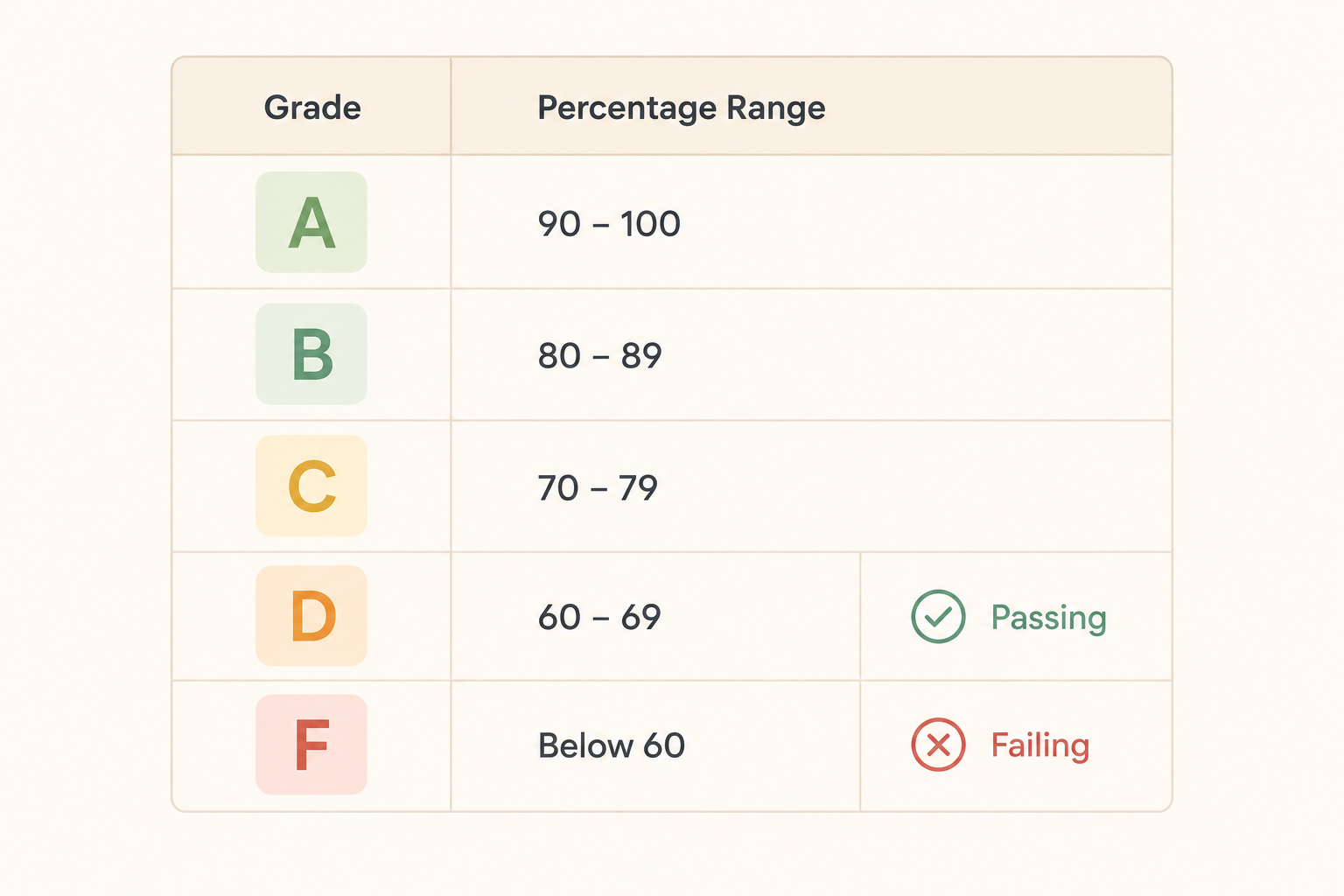
In most US schools, a passing grade is anything from a D up. On the usual scale that means 60% or higher. A D is the lowest grade that still earns you credit for the class, while anything below 60% is an F, which does not pass.
Here is the quick view on the standard scale. A, B, and C all pass comfortably. A D passes, but only just. An F fails. So 60% is the line most schools draw between passing and failing.
The catch is that this line moves depending on your level and your class. The next sections go through high school, college, and your major, since each one can ask for more.
Passing grade in high school
In most US high schools, a D is a passing grade, so 60% is usually enough to pass a class and earn credit. For a lot of general classes, that is the bar.
But core subjects can be stricter. Many schools want a C, around 70%, in classes like math, English, or science, because you need them to graduate. Some districts also set their own minimum, so two students in different schools can face different lines. If you are close to the edge, check your school's policy or ask your teacher, since passing a required class matters more than passing an elective.
Passing grade in college
In college, a D usually passes a class on paper, so 60% still earns the credit. But college adds an important twist. Many programs will not count a D toward your major or your graduation requirements.
Most majors ask for a C or higher in the classes that count for your degree. Fields like nursing often require at least a C to move on. Graduate school is stricter still, where a C is usually the lowest passing grade and anything below can put you at risk. So in college, "passing" and "good enough to count" are not always the same thing, which the next section explains.
Is a D a passing grade?
Yes and no, and this trips a lot of students up. A D does pass the class in most schools, so you earn the credit and you do not have to be there again. By the basic rule, 60% is passing.
The problem is what a D does not do. It often will not count toward your major, so you may have to retake the class anyway to meet your degree requirements. A D also drags your GPA down, since it is only worth 1.0 grade point. So a D keeps you out of the fail column, but it is worth checking whether it actually counts for what you need. When it does not, retaking it for a higher grade is usually the better move.
Passing GPA and good academic standing
Passing single classes is one thing, but schools also look at your GPA as a whole. To stay in good standing, most colleges want undergraduates to keep at least a 2.0 GPA. Graduate students usually need a 3.0.
If your GPA drops below that line, you can land on academic probation, even if you technically passed your classes. Probation is a warning, with a term or two to bring your GPA back up. So it helps to watch your overall GPA, not just each grade. Passing every class with D's can still leave you below a 2.0, which is why those low grades are worth avoiding.
Pass or fail classes
Some classes are graded pass or fail instead of with a letter. Here you do not get an A, B, or C. You just get a Pass or a Fail on your record.
The bar for a Pass is often higher than a plain D. At many schools you need a C or better to earn the Pass. The upside is that a pass or fail class usually does not affect your GPA, so it will not pull your average down.
Students often use this option for an elective outside their major, so they can take a harder class without risking their GPA. Check how your school handles it before you choose this route, since the rules vary.
Check where your grade lands
If you are not sure whether your score passes, it helps to see the letter behind it. Our free Letter Grade calculator turns any percentage into a letter grade, so you can tell at a glance if you are above the passing line.
To see the full ranges, the Grade Scale calculator lays out every letter and its percentage band. And to check how a grade affects your overall standing, the GPA calculator shows where your average sits. All free, no signup.
Conclusion
For most classes, a passing grade is a D, or 60%. That is the line between earning credit and failing. But that simple answer hides a few things worth remembering. High school core classes can ask for a C, college majors usually will not count a D, and graduate programs often treat a C as the lowest pass. So always check the rule for your level and your class, not just the basic 60%.
It also helps to think past a single grade. A D may pass, but it is only worth 1.0 grade point, so a string of them can pull your GPA under the 2.0 most schools want for good standing.
If a grade passes the class but does not count toward your major, retaking it for a higher score is often the smarter move. Knowing your real passing line, and keeping an eye on your overall GPA, keeps you out of trouble and on track to graduate.