How to Raise Your GPA
Raise your GPA with steps that actually work. Focus on the right grades, retake smartly, pick high-credit classes, and track it with a free GPA calculator.
 By Dhananjay Kumar Nirala , Writer schedule 5 min read
chevron_right On this page 7 sections
Want to raise your GPA but not sure where to start? The fastest gains come from a few simple moves. Lift the grades you can still change, recover any missing work, and put your effort into the classes that count for the most.
This guide walks through what actually works, in both high school and college, and links to a free GPA calculator so you can set a target and track it.
Start with the grades you can still change
The quickest way to lift your GPA is to work on the grades that are not final yet. A class still in progress can move, while a class from last year cannot. So put your energy where it still counts.
Inside those classes, aim at the big assignments. Midterms, finals, and major projects often make up half the grade or more, so doing better on one of them shifts your score far more than a small quiz. Look for any missing work too.
A single zero pulls a grade down hard, and turning in late work or asking about extra credit can win back more points than weeks of normal studying.
Why high-credit classes move your GPA most
Not every class pulls on your GPA the same way. A GPA is weighted by credit hours, so a class worth more credits counts for more. An A in a 4-credit class lifts your GPA more than an A in a 1-credit elective.
This matters when you decide where to spend your time. If you have to choose, put the extra effort into your high-credit classes, since that is where a better grade does the most. The same logic works in reverse. A low grade in a big class hurts more, so those are the ones worth protecting first.
It also helps when planning next term. A balanced course load you can handle will do more for your GPA than a packed schedule that leaves you stretched too thin.
Retaking a class to replace a grade
If one bad grade is dragging down your GPA, retaking that class can be one of the fastest fixes. Many schools offer grade replacement, where the new grade takes the place of the old one in your GPA. That can lift your cumulative GPA quickly, since you remove a low score instead of just adding new ones.
The catch is that policies vary a lot. Some schools fully replace the old grade, others average the two attempts, and some count both. There is also often a limit on how many classes you can retake this way. So check your school's repeat policy before you count on it.
When it does apply, retaking a high-credit class you did poorly in usually gives the biggest jump. Ask your advisor or registrar so you know exactly how your transcript will show it.
How much can you realistically raise your GPA?
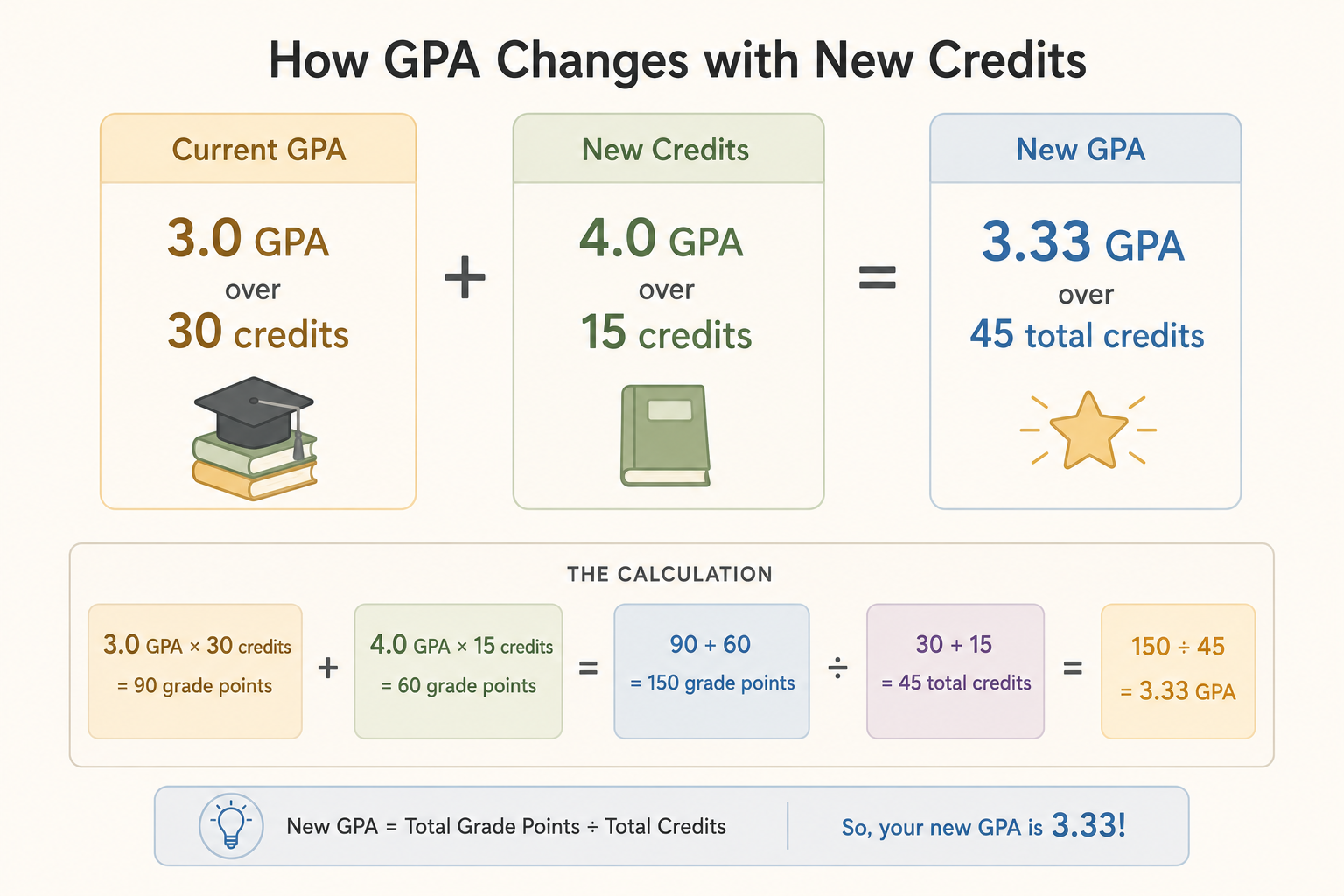
It helps to be honest about the math. A single semester can move your GPA, but a cumulative GPA built over years moves slowly, because every past grade is still in the mix.
Here is a simple example. Say you have a 3.0 GPA across 30 credits. You take another 15 credits and earn straight A's, a 4.0. Your new GPA is (3.0 × 30 + 4.0 × 15) ÷ 45 = 150 ÷ 45 = 3.33. A strong semester helped, but it did not jump to 4.0, because the older grades still count.
The lesson is that the earlier you start, the more room you have. If you have several terms left, you can change your GPA a lot. If you are near the end, focus on realistic gains and on finishing strong rather than chasing a number that the math will not allow.
Study habits that actually help
Strategy only works if the day-to-day studying backs it up. A few habits make the biggest difference here.
A steady study schedule beats last-minute cramming. When you spread the work across the week, you remember more and stress less near exams. Break a big goal, like moving from a 2.8 to a 3.2, into smaller targets for each class, so it feels doable instead of huge.
Ask for help sooner rather than later. A tutor, a study group, or office hours can clear up a topic before it costs you on a test. Most students who get steady help see their grades climb, as long as they keep at it.
Set a target and track it
It is much easier to raise your GPA when you know the exact number you are aiming for. Pick a target, then check what grades this term will get you there. Our free GPA calculator lets you add your classes and credits and see your GPA update as you go.
The Final Grade calculator is handy too, since it shows what you need on an upcoming exam to hit a course grade. Seeing the real numbers keeps your goal honest and tells you early if you need to adjust. Both are free with no signup.
Conclusion
Raising your GPA is less about one big push and more about smart, steady choices. Protect your high-credit classes, fix the zeros, retake a weak grade if your school allows it, and start as early as you can. Set a target, track your progress, and finish each term as strong as you can.